
Lecture: Beyond Paper and Curtain: Architectural Works and Humanitarian Activities of Shigeru Ban

April 24, 2000
Note: This program was originally scheduled for April 10th
Lecture: Beyond Paper and Curtain: Architectural Works and Humanitarian Activities of Shigeru Ban
Shigeru Ban (Architect; Visiting Fellow of the Donald Keene Center)
Wood Auditorium, Avery Hall, Columbia University (115th St. and Broadway)
6:30 PM
RSVP REQUIRED: Seating is limited. Please call 212-854-5036
 |
|
Paper Gallery, 1994
|
SHIGERU BAN, the brilliantly innovative Japanese architect, will speak about his work both as a designer and as a social activist encouraging the world’s architects and builders to produce safe, low-cost shelters for victims of earthquakes and other natural disasters. He is best known for his cardboard-pillared buildings that have served as elegant permanent private homes and galleries, and also as temporary shelters for millions of people left homeless after massive earthquakes in Japan and Turkey. Architect for the Japanese pavilion at the International Exposition 2000 in Hannover, Mr. Ban will also construct a special structure this summer in the garden of the Museum of Modern Art. In 1995, he established the NGO called VAN (Volunteer Architects Network), and he serves as Special Consultant to the United Nations High Commissioner for Refugees. In November 1999, Herbert Muschamp wrote of Shigeru Ban in the New York Times:
“…. In the last five years, Ban has responded to the news of earthquakes and other disasters as if to a call of conscience. After the Kobe quake in 1994, Mr. Ban designed units of cardboard and plastic housing for the thousands who had been driven from their homes. The following year, he established the Volunteer Architects Network, a non-governmental agency of the United Nations. This year, under the aegis of that agency, he has coordinated the production and shipment of cardboard housing units for refugees in Turkey.
It happens that Mr. Ban is also a brilliant designer of private houses, apartment houses, public buildings and museum exhibitions. In these, he has displayed a striking talent for innovative form, structure and spatial organization. This diverse body of work plays havoc with our Western inclination to plug architects into mutually exclusive categories: the artistically gifted or the socially committed. In Mr. Ban’s case, they stem from the same outlook… In his work, we are invited to see the social dimension within the aesthetic, the artist inside the humanitarian.”
Co-sponsored with the Graduate School of Architecture, Planning, and Preservation, Columbia University
Mr. Ban is a Visiting Fellow of the Donald Keene Center, under a program supported by the United States-Japan Foundation
BAN Shigeru (Architect)
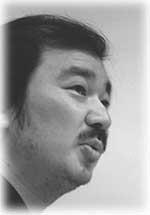 One of Japan’s leading younger architects, Mr. Ban gained international attention for his low-cost quickly built relief structures, using durable cardboard tubing, built in Kobe immediately following the earthquake of January 1995. He has since constructed similar buildings for victims of earthquakes and other natural disasters in Turkey and Rwanda.
Born in 1957, Mr. Ban received his architecture degree from The Cooper Union (NY), following study at the Southern California Institute of Architecture. He worked in the architecture firm of Arata Isozaki (1982-83). In 1995, Mr. Ban established an NGO called Voluntary Architects Network (VAN) and soon afterward was made special consultant of the UN High Commission of Refugees (UNHCR). He is also active as a designer of private homes, apartment houses and public-housing developments, galleries, museums, railway stations for JR, and furniture and industrial designs.
Mr. Ban’s awards include: SD Architect of the Year (1985); Tokyo Society of Architects House Award (1993); Mainichi Design Prize (1995); Tokyo Journal Innovative Arts Award (1996); Shinkenchiku Magazine Yoshioka Award (1996); Intl. Architects Academy Ecopolis Award (1996); Japan Institute of Architects Best Young Architect of the Year Award (1997); JIA Tohoku Award (1998).
Mr. Ban presented a lecture entitled “Beyond Paper and Curtain: Architectural Works and Humanitarian Activities of Shigeru Ban” at Columbia University on April 24, 2000, which was co-sponsored by the Donald Keene Center and the Graduate School of Architecture, Planning & Preservation. Two days after his lecture at Columbia a large environmental structure of Ban’s opened in the garden of the Museum of Modern Art in New York, and remained as a tem porary installation in the MoMA until August. In June, Mr. Ban’s design for the Japanese Pavilion opened at Expo 2000 in Hanover, Germany, and was acclaimed as the most successful Pavilion at the 2000 World’s Fair.
Mr. Ban returned to Columbia in the fall semester of 2000 to teach an Architecture Studio course at Columbia. As part of this course, Mr. Ban graciously offered to have students accompany him to Turkey, where he was instrumental in constructing temporary shelters for the thousands of people who were left homeless after a massive earthquake struck in 1999. He completed his Visiting Fellow activities in February 2001, when he presented various public lectures at the New Jersey Institute of Technology, The Cooper Union, Massachusetts Institute of Technology, Japan Society (New York), and the Graham Foundation/Architecture and Design Society of the Art Institute of Chicago.


