
Lecture: Japanese Language, Literature, and Pedagogy: Inflections as Discourse in Classical Japanese

May 18, 2001
Lecture: Japanese Language, Literature, and Pedagogy: Inflections as Discourse in Classical Japanese
Professor Charles Quinn (Associate Professor of Japanese, Director of the Japanese Language Program, Department of East Asian Languages and Cultures, Ohio State University)
403 Kent Hall, Columbia University (116th St. & Amsterdam Ave.)
12:00 PM-1:00 PM
Co-sponsored by the Department of East Asian Languages and Cultures
KORE-EDA Hirokazu (Film Director)
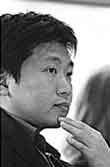 One of Japan’s most promising young film directors, Mr. Kore-eda came to international attention in 1995 when Maboroshi, his first narrative feature film, was screened at the Venice Film Festival and awarded the Ozella D’oro. The film was shown at more than twenty film festivals and won numerous awards. His second narrative feature, After Life (1998) also received wide acclaim. Mr. Kore-eda recently completed his third film, Distance, a featured entry at this year’s Cannes Film Festival.
Born in 1962, Mr. Kore-eda received his B.A. degree in Literature from Waseda University in 1987, and then joined TV Man Union Inc., a television production company in Tokyo. Prior to his narrative debut, Kore-eda directed and produced award-winning documentary films for Japanese television (on subjects such as an H.I.V. patient; a Korean trying to “pass” in Japanese society; and the Taiwanese filmmakers Hou Hsiao-hsien and Edward Yang).
Mr. Kore-eda came to New York as a Visiting Fellow in April 2001. During his short stay, Mr. Kore-eda participated in a Directors’ Panel Discussion that was the highlight of the eight-week “Countries and Cities in East Asian Film” series at Columbia University’s Roone Arledge Cinema. The film series incorporated films from Japan (including Maboroshi and After Life), Korea and Taiwan, and was co-sponsored by the Donald Keene Center, the Richard W. Weatherhead Fund of the East Asian Institute, the Department of East Asian Languages and Cultures, the Film Division of the School of the Arts, and the Chiang Ching-Kuo Foundation Center for Chinese Cultural and Institutional History. The other participants in the Panel Discussion were Hou Hsiao-hsien (Taiwanese Director of City of Sadness and Dust in the Wind, and Mr. Kore-eda’s mentor), Linda Hoagland (Japanese Film Specialist and Interpreter for Mr. Kore-eda), Chu T’ien-wen (Screenwriter), Peggy Chiao (Taiwan Film Center), Paul Anderer (Japanese Literature and Film, Columbia University), and David D. W. Wang (Chinese Literature and Film, Columbia University). Mr. Kore-eda also participated in a discussion session with Columbia and Barnard University film and literature students, presented a visiting directors workshop for the students of the New York University Graduate Film Program, and discussed his works at the Screening Room following a showing of After Life by the film’s distributor Artistic License Films.


