
Workshop: Setsuwa (Folk Literature) and Media

October 18, 2001
Note: This program was originally scheduled for 1:00 PM ~ 4:00 PM
Workshop: Setsuwa (Folk Literature) and Media
Professor Kazuaki Komine (Professor in the Department of Literature, Rikkyo University; Visiting Fellow of the Donald Keene Center of Japanese Culture)
403 Kent Hall, Columbia University (116th St. & Amsterdam Ave.)
10:30 AM-1:30 PM
Please note that parts of this workshop will be conducted in Japanese. If you have any questions or would like more information, please call the Donald Keene Center at 212-854-5036 or email us at donald-keene-center@columbia.edu
 |
|
Chôjû giga
|
This workshop will take a fresh look, from a setsuwa-oriented perspective, at emaki (picture scrolls) as a medium. Beginning with gajushi, the words written in emaki, we will analyze the negotiations and interrelationships between emaki and setsuwa. We will examine such emaki texts as Choju giga (Scrolls of Frolicking Animals) and Junirui emaki (Scrolls of the Twelve Animals) from a variety of perspectives.
Co-sponsored by the Institute for Medieval Japanese Studies and the Department of East Asian Languages and Cultures
Professor Komine is a Visiting Fellow of the Donald Keene Center, under a program supported by the United States-Japan Foundation
KOMINE Kazuaki (Professor of Literature)
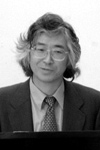 Komine Kazuaki, a professor in the Department of Literature at Rikkyo University, is a world-renowned scholar in the field of setsuwa (folk) literature in Japan, working from the ancient period through early modern. Professor Komine received his B.A., M.A., M. Phil., and Ph.D. in Literature from Waseda University, and has taught at Rikkyo University since 1985. He has also taught at the National Institute of Japanese Literature (1981-1985) and in the School of Liberal Arts at Tokushima University (1979-1984). He is the author of numerous publications, including: Setsuwa no koe (The Voices of Setsuwa), Shinyo-sha, 2000; Uji shûi monogatari no hyôgen jikû(The Expressive Space-Time of Tales Gleaned in Uji), Chûsei bungaku kenky û soshô 10 Medieval Literature Research Library, vol. 10), Wakakusa Shobô, 1999; Chûsei setsuwa no sekai o yomu (Reading the World of Medieval Setsuwa), Iwanami Shoten, 1998; and Setsuwa no mori (The Forest of Setsuwa Literature), Taishû-kan Shoten, 1991. Professor Komine’s awards include the Waseda University Literature Association Kubota Utsubo Prize (1981) and the Japan Premodern Literature Association Prize (1982).
During his stay as a Visiting Fellow of the Donald Keene Center (September to October 2001), Professor Komine conducted a series of four workshops at Columbia University. The workshops were attended by graduate students and scholars working in the fields of history, religion, art history, and literature at Columbia and other New York institutions. One of the highlights of this series was the final workshop held on October 18, 2001, which was open to the general public. The event was entitled Setsuwa (Folk Literature) and Media, and was co-sponsored by the Donald Keene Center of Japanese Culture, the Institute for Medieval Japanese Studies and the Department of East Asian Languages and Cultures at Columbia. The workshop took a fresh look, from a setsuwa-oriented perspective, at emaki (picture scrolls) as a medium. Beginning with gajûshi, the words written in emaki, Professor Komine analyzed the negotiations and interrelationships between emaki and setsuwa. He examined such emaki texts as Choju giga (Scrolls of Frolicking Animals) and Jûnirui emaki (Scrolls of the Twelve Animals) from a variety of perspectives. In this hands-on workshop, participants also viewed and handled scrolls and other significant pieces from the rare books collection of Columbia University’s C.V. Starr East Asian Library.
As part of the Visiting Fellows Program, Professor Komine also presented various lectures and workshops at Indiana University, Yale University, Princeton University, and Cornell University. In addition, his stay in the U.S. allowed him to participate in a three-day manuscript survey at the Library of Congress. Professor Komine pursued his research at Yale University’s rare book library and at the New York Public Library’s Spencer Collection, and made major finds at both locations. At Yale he came across a Taketori monogatari ehon that had not previously been identified, and at the Spencer Collection he found a hitherto unknown variant on the Junirui emaki, which provided a major missing link on the study of this scroll.


