
Gloss Writing in the 8th Century: Korean Kugyŏl and the Origins of Japanese Kanbun

May 1, 2008
Gloss Writing in the 8th Century: Korean Kugyŏl and the Origins of Japanese Kanbun
John Whitman (Professor, Cornell University)
403 Kent Hall, Columbia University (116th St. and Amsterdam Ave.)
6:00 – 7:30 PM
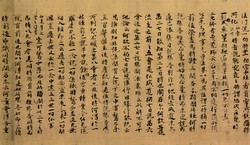 This talk concerns a manuscript that was destroyed in the B-29 raid on Tokyo on April 15, 1945. One side was an untitled, undated text known as the Tôdaiji fuju monkô (Draft of a Sermon for Tôdaiji Temple). On the reverse side was inscribed one of two extant copies of a sutra commentary, the Kegon mongi yôketsu (Key to the Text and Meaning of the Avatamsaka Sutra), approximately datable to the late eighth century. In the 1930s Yamada Yoshio and others noticed that the Tôdaiji fuju monkô was the earliest example of “mixed” kanji and katakana writing, with katakana written by the same hand, on the same line (as well as in the margin) as Chinese characters in the text. The Kegon mongi yôketsu similarly attracted attention among scholars, including Kobayashi Yoshinori, who showed that the system of glossing (kunten) it uses is nearly identical to those in stylus-pointed texts from the ancient Korean states of Late Shilla and Koryo. This discovery has led to a flurry of interest in the hypothesis that kunten glossing technology was brought from Shilla to Nara in the mid- to late eighth century, as part of the transmission of Huayan/Kegon doctrine and texts at that time. In his talk, Prof. Whitman will look at the two texts in brief detail. He will discuss what it means to gloss a text “to be read in a language” and will consider the relationship between glossing and construction of a written vernacular.

