
The Pursuit of Harmony: Poetry and Power in Early Heian Japan.

November 19th, 2009
6:00 – 7:30 PM
“The Pursuit of Harmony: Poetry and Power in Early Heian Japan.”
A Book Talk with Gustav Heldt
Gustav Heldt (University of Virginia)
Location: 403 Kent Hall, Columbia University (116th St. and Amsterdam Avenue)
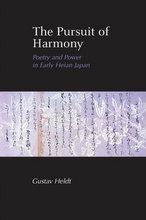 The speaker’s recent book The Pursuit of Harmony: Poetry and Power in Early Heian Japan concerns the creation of new forms of poetry in the 9th and early 10th centuries – such as poetry matches, screen poetry, and imperial anthologies – which that helped define Japanese court culture for centuries afterwards. Its aim is to demonstrate how aspects of poetic praxis, and particularly that of “harmonization” in verse, can offer new understandings of Heian poetry’s textual, ritual, cosmological, social, and political dimensions.
Lecturer information: Gustav Heldt is Associate Professor of Japanese Literature at the University of Virginia, specializing in the poetry and cultural history of early and medieval Japan. He received his Ph.D. in Japanese Literature from Columbia University in 2000. His recent publications include “Writing Like a Man: Poetic Literacy, Textual Property, and Gender in the Tosa Diary,” Journal of Asian Studies (2005), and “Between Followers and Friends: Male Homosocial Desire in Heian Court Poetry,” forthcoming in the U.S.-Japan Women’s Journal.
 Supported by the Japan Foundation.
November 23rd, 2009 (Monday) 12:00-1:30 PM
**Brown Bag Lunch**
“The New Sensibility of Recession in Japan”
Andrea Arai (University of Washington)
Location: 918 International Affairs Building, Columbia University (116th St. and Amsterdam Avenue)
Lecturer information: Andrea Arai teaches in the Jackson School of International Studies Japan Studies Program at the University of Washington. She is completing an edited volume, entitled Global Futures in East Asia, with Ann Anagnost, and is the author of one of its chapters, “Notes to the Heart: Learning to ‘Love Your Country’ in Neoliberal Japan.” Professor Arai is also finishing a book manuscript, provisionally titled Recessionary Sensibilities, on the new effects of time and value in the economic downturn from the 1990s and the reshaping of realities and representations of Japan and its youth amid restructurings of education and labor. Her recent publications include “The Neoliberal Subject of Lack and Potential: Developing the ‘Frontier Within’ and Creating a Reserve Army of Labor in Japan” (2005), and “The ‘Wild Child’ of 1990s Japan,” in the book Japan After Japan: Social and Cultural Life from the Recessionary 1990s to the Present (2006).
Co-Sponsored by the

Supported by the Japan Foundation.


